
Winter Canvas Print FAQ: Everything You Need to Know Before You Buy
Last Updated: November 2025 | Reading Time: 8 minutes
Thinking about adding winter nature photography to your walls? You're not alone. Our Winter Frozen collection has sparked hundreds of questions from nature lovers, interior designers, and first-time art buyers alike.
As a professional macro photographer who's spent the last decade capturing Washington State's transitional seasons, I've learned that the technical side of canvas prints can be confusing. Should you frame them? What size works best? Will the colors fade?
This comprehensive guide answers every question we've received about our winter canvas prints—from the photography process to display options to long-term care. Whether you're decorating your first apartment or you're a seasoned art collector, you'll find everything you need to make an informed decision.
About the Photography
Are these real photographs or digital art?
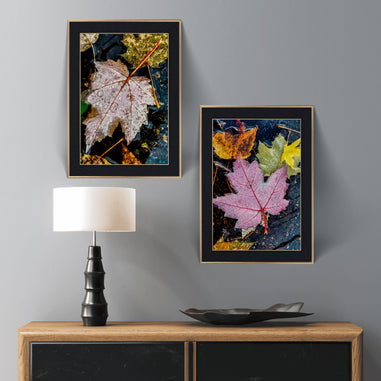
These are 100% authentic macro photographs of real leaves and snow—no digital manipulation, no artificial elements, no stock photography.
Every image in our Winter Frozen collection was captured during the brief 3-5 day window when Washington State's autumn leaves meet winter's first snowfall. This fleeting intersection happens only once per year, typically in late November or early December, and requires perfect timing.
I use professional macro lenses (100mm f/2.8 and 180mm f/3.5) that allow 1:1 magnification ratio or greater. This means the image projected onto my camera sensor is the same size as the actual subject—revealing details completely invisible to the naked eye.
What you see in these prints:
- Individual snow crystal formations
- Microscopic water droplets acting as natural magnifying lenses
- Intricate leaf vein patterns and cellular structure
- Light refraction creating rainbow effects in water
- Texture details down to 0.1mm resolution
This level of detail is what separates authentic macro photography from standard nature photography or digitally created art.
When and where were these winter photos taken?
Location: Pacific Northwest forests, primarily in Washington State's Cascade Mountain foothills and Olympic Peninsula regions.
Timing: Late November through early December, during the narrow window when:
- Autumn leaves are still attached to branches (not yet fallen)
- Leaves retain vibrant burgundy, crimson, and red pigmentation
- First snowfall occurs (typically 1-3 inches)
- Temperatures hover around 28-35°F (cold enough for snow, warm enough for leaves)
Weather conditions: I specifically wait for gentle snowfall followed by clearing skies. This creates the perfect combination of:
- Fresh, pristine snow crystals (not melted or refrozen)
- Soft, diffused natural light (no harsh shadows)
- Water droplets from melting snow (adds dimension)
- Golden hour lighting (warm tones that complement red leaves).
What makes macro photography special for home décor?
Macro photography creates a unique psychological effect that standard nature photography can't replicate: intimate wonder.
When you view a landscape photograph, you appreciate its beauty from a distance. But when you view macro photography, you're seeing something you could never experience in person—even if you were standing right there.
The benefits for your space:
- Conversation Catalyst Guests consistently stop and ask, "What am I looking at?" The unfamiliar perspective sparks curiosity and engagement.
- Mindfulness Trigger The intricate details naturally slow down your gaze. You find yourself studying the image rather than glancing past it—creating moments of present-awareness throughout your day.
- Biophilic Connection Research from the University of Melbourne shows that viewing nature details (not just nature scenes) activates the same neural pathways as being outdoors. Macro photography provides this connection even in urban environments.
- Timeless Appeal Unlike trendy abstract art or seasonal décor, authentic nature photography remains relevant across decades and design trends.
Why are the colors so vibrant?
The deep burgundy, crimson, and red tones you see are authentic autumn leaf colors—not enhanced or manipulated.
The science behind the colors:
Autumn leaves contain anthocyanins—the same pigments that create red wine color and blueberry hues. When temperatures drop below 45°F, these pigments become more concentrated and visible as chlorophyll breaks down.
Early winter cold (28-35°F) preserves these anthocyanins before leaves fall, creating the most intense red coloration of the entire year. This is why winter-captured autumn leaves show richer colors than October foliage.
My photography process maintains color accuracy:
- Shoot in RAW format - Captures maximum color data
- Use color calibration targets - Ensures accurate color reproduction
- Professional color grading - Matches what I saw in person
- Print calibration - Museum-grade inks reproduce true colors
- No artificial saturation - Colors are authentic, not exaggerated.
The white snow provides natural contrast that makes the red tones appear even more vibrant—a phenomenon called simultaneous contrast in color theory.
Product Specifications
What does "unframed canvas" or "unstretched canvas" mean?
"Unframed canvas" and "unstretched canvas" mean the same thing: high-quality canvas material printed with your image, delivered flat (not mounted on wooden bars or placed in a frame).
What you receive:
- Premium cotton-poly blend canvas
- Printed with museum-grade archival inks
- Rolled or flat-packed for shipping protection
- Ready for your choice of display method.
What you DON'T receive:
- Wooden stretcher bars
- Frame
- Hanging hardware.
Why we offer unstretched canvas:
1. Display Flexibility You choose how to display it:
- Frame behind glass (classic look)
- Professional stretching (modern gallery-wrap)
- Float mounting (contemporary style)
- Custom framing to match your existing décor
2. Budget Control Framing costs vary dramatically by region and style. Unstretched canvas lets you:
- Use an affordable ready-made frame ($15-40)
- Invest in custom framing ($100-300)
- DIY stretch it yourself ($20-50 in materials).
3. Shipping Safety Framed/stretched canvases are bulky and fragile. Flat canvas ships safely in rigid mailers with minimal risk of damage.
4. International Friendly Customers outside the US avoid expensive international shipping for bulky frames.
What are the material specifications?
Canvas Material:
- Composition: 65% polyester, 35% cotton blend
- Weight: 360 GSM (grams per square meter) - premium heavyweight
- Texture: Medium canvas weave (visible texture adds depth)
- Finish: Matte (eliminates glare, museum-quality appearance)
- Opacity: 100% (no show-through from wall behind).
Ink & Printing:
- Ink Type: Archival pigment-based inks (not dye-based)
- Fade Resistance: Rated for 75+ years under normal indoor lighting
- Resolution: 300 DPI (dots per inch) - professional print quality
- Color Gamut: Wide color gamut ensures accurate reds and burgundies
- Print Method: Giclée printing process (fine art standard).
Durability:
- Water Resistance: Canvas naturally resists moisture
- UV Protection: Inks contain UV inhibitors
- Scratch Resistance: Canvas texture hides minor surface marks
- Flexibility: Won't crack or peel when rolled or stretched
What sizes are available?
We offer two product types with multiple sizing options:
Unframed/Unstretched Canvas:
- Available in sizes from 6x8 inches to 17x22 inches
- Designed to fit standard frames
- Perfect for framing like traditional paper prints.
Framed/Wrapped Canvas:
- Available in sizes from 8x10 inches to 30x60 inches
- Ready to hang immediately
- Gallery-wrapped and framed for instant display.
Each product is available in 5-6 different size options to suit your space perfectly.
All sizes are:
- Square, Vertical & Horizontal orientation (portrait/landscape format)
- Sold as 2-4-piece coordinating sets, and as single prints
- Printed at the same scale (consistent detail across sizes).
Can I order custom sizes?
Currently, our Winter Frozen collection is available in the 5-6 standard sizes listed above. These sizes were specifically chosen because they:
- Match standard frame sizes - Easy to find affordable frames
- Maintain optimal image quality - Printed at ideal resolution
- Work with most spaces - Cover 90% of common wall dimensions
- Keep costs accessible - Standard sizes = lower production costs.
For custom sizing inquiries:
- Email us at info@thevirtueofgodbrand.com
- Minimum order: 5 sets for custom sizes
- Custom sizing available for: Interior designers, corporate installations, hospitality projects.
Display & Framing Options
How do I display unstretched canvas prints?
You have three main display options, each creating a different aesthetic:
Option 1: Frame Behind Glass (Classic Look)
What it is: Place canvas in a standard picture frame with glass, just like a traditional print or poster.
Best for:
- Traditional or classic décor styles
- High-moisture areas (bathrooms, kitchens)
- Maximum protection from dust and damage
- Budget-conscious buyers.
How to do it:
Purchase standard frames in your canvas size:
- IKEA: $10-25 per frame
- Target/Walmart: $15-30 per frame
- Amazon: $20-40 per frame
- Michael's/Hobby Lobby: $25-50 per frame (use 50% off coupons!).
Choose frame color:
- Black frames: Modern, dramatic, makes colors pop
- White frames: Clean, minimalist, Scandinavian style
- Natural wood: Warm, organic, complements nature photography
- Gold/silver: Traditional, elegant, formal spaces.
Insert canvas like a print:
- Remove backing from frame
- Place canvas face-up
- Replace glass and backing
- Hang using included hardware.
Pro tip: Use mat boards (available at craft stores) to create a border between canvas and frame edge. This adds a professional gallery look.
Option 2: Gallery Wrap / Stretched Canvas (Modern Look)
What it is: Canvas stretched over wooden bars, creating a 3D object that hangs directly on the wall without a frame.
Best for:
- Modern, contemporary, or minimalist décor
- Creating a "floating" art effect
- Gallery-style displays
- Buyers who want a polished, professional look.
How to do it:
DIY Method ($20-50 per print):
Purchase stretcher bars:
- Available at Michael's, Hobby Lobby, or Amazon
- Buy bars matching your canvas size (e.g., two 16" bars + two 20" bars for 16×20")
- Choose depth: 0.75" (standard) or 1.5" (gallery depth).
Assemble frame:
- Connect bars at corners (they slot together)
- Ensure corners are square (use a carpenter's square).
Stretch canvas:
- Center canvas face-down
- Staple center of one side to back of bars
- Pull tight and staple opposite side
- Repeat for remaining two sides
- Work outward from center, pulling tight
- Fold corners neatly and staple.
Professional Method ($40-120 per print):
Take your canvas to a local frame shop. They'll:
- Stretch it over professional-grade bars
- Ensure perfectly tight, wrinkle-free surface
- Fold corners with museum-quality technique
- Add hanging hardware
- Typically takes 3-7 days
- Cost: $40-60 for small sizes, $80-120 for large sizes.
Pro tip: Ask for gallery wrap (image wraps around edges) vs. museum wrap (white edges). For our prints, gallery wrap looks best.
Option 3: Float Mounting (Contemporary Look)
What it is: Canvas mounted on rigid backing board, then "floated" away from the wall using spacers, creating a shadow effect.
Best for:
- Ultra-modern or contemporary spaces
- Architectural or minimalist interiors
- Creating visual depth
- High-end installations.
How to do it:
1. Mount canvas on foam board:
- Use spray adhesive or double-sided tape
- Smooth out any bubbles.
2. Attach standoffs:
- Small metal or acrylic spacers (available on Amazon)
- Screw into wall, then attach board
- Creates 0.5"-1" gap between wall and art.
3. Alternative: Take to professional framer for float mounting in a shadow box frame
Cost: $60-150 per print (professional mounting recommended)
Which display method do you recommend?
For most buyers, I recommend Option 1 (framing behind glass) because:
✅ Most affordable: $10-50 per frame ✅ Easiest: No special skills required ✅ Protective: Glass shields from dust, moisture, damage ✅ Flexible: Easy to change frames later ✅ Widely available: Frames sold everywhere
Choose Option 2 (gallery wrap) if:
- You want a modern, frameless look
- You're comfortable with DIY or have budget for professional stretching
- Your space has a contemporary aesthetic.
Choose Option 3 (float mounting) if:
- You have a high-end, architectural space
- Budget isn't a primary concern
- You want maximum visual impact.
Do I need glass/acrylic protection?
Short answer: Not required, but recommended for longevity.
Without glass protection:
✅ Canvas is durable and naturally moisture-resistant
✅ Matte finish won't show fingerprints easily
✅ Archival inks resist fading for 75+ years
❌ Exposed to dust accumulation
❌ Vulnerable to accidental scratches or spills
❌ Faster fading in direct sunlight.
With glass protection (framed):
✅ Maximum protection from dust, moisture, damage
✅ Easy to clean (wipe glass with glass cleaner)
✅ UV-filtering glass available for extra fade protection
✅ Maintains pristine condition for decades
❌ Adds glare (unless you use non-glare glass)
❌ Slightly more expensive.
My recommendation: Frame behind glass for high-traffic areas (living rooms, hallways) and moisture-prone areas (bathrooms, kitchens). Gallery wrap is fine for bedrooms and offices with less exposure.
Sizing & Placement Guide
Which size should I choose for my space?
Use this decision framework:
8×10", 8x12" - The Versatile Small
Best for:
- Bathrooms and powder rooms
- Home office desks (lean against wall or use easel)
- Gallery walls (mix with other art)
- Bookshelves and built-ins
- Small bedrooms or dorm rooms
- Narrow wall spaces (between windows, beside doors).
Viewing distance: 2-4 feet Wall space needed: 10-12" wide × 12-16" tall (with frame) Visual impact: Intimate, detail-focused
Arrangement ideas for 3-piece set:
- Vertical column on narrow wall
- Horizontal row above desk
- Scattered across bookshelf
- Part of larger gallery wall (9-12 pieces total).
9×12", 11x14" - The Goldilocks Size
Best for:
- Bedrooms (above nightstands or dressers)
- Home offices (above desk or filing cabinet)
- Hallways and entryways
- Dining room accent walls
- Apartment living (maximizes impact in smaller spaces).
Viewing distance: 3-5 feet Wall space needed: 11-14" wide × 14-18" tall (with frame) Visual impact: Noticeable without overwhelming
Arrangement ideas for 3-piece set:
- Vertical column flanking a doorway
- Horizontal row at eye level
- Staggered diagonal (dynamic flow)
- Above a console table or dresser.
12×16", 12x18" - The Living Room Standard
Best for:
- Living rooms (above sofas, accent walls)
- Master bedrooms (above bed or dresser)
- Home offices (focal point wall)
- Dining rooms (above buffet or sideboard)
- Larger bathrooms (above tub or vanity).
Viewing distance: 5-8 feet Wall space needed: 14-16" wide × 18-22" tall (with frame) Visual impact: Strong focal point
Arrangement ideas for 3-piece set:
- Horizontal row above sofa (most popular)
- Vertical column on tall wall
- L-shape around corner
- Separated across three walls in open floor plan.
14×18" - The Statement Maker
Best for:
- Large living rooms (focal wall)
- Master bedrooms (above king bed)
- Dining rooms (main wall)
- Office conference rooms
- Entryways with high ceilings
- Stairway walls.
Viewing distance: 6-10 feet Wall space needed: 16-18" wide × 20-22" tall (with frame) Visual impact: Commanding presence
Arrangement ideas for 3-piece set:
- Horizontal row (needs 60"+ wall width)
- Vertical column (needs 72"+ wall height)
- Separated as focal points in different rooms.
16×20", 16x24" - The Dramatic Impact
Best for:
- Large living rooms with high ceilings
- Above king beds in spacious master bedrooms
- Dining rooms in open-concept homes
- Corporate offices and reception areas
- Hospitality spaces (hotels, spas, waiting rooms)
- Homes with 10'+ ceilings.
Viewing distance: 8-12 feet Wall space needed: 18-20" wide × 22-26" tall (with frame) Visual impact: Gallery-quality statement piece
Arrangement ideas for 3-piece set:
- Horizontal row (needs 72"+ wall width)
- Vertical column (needs 84"+ wall height)
- Separated as primary focal points in three different rooms.
How do I measure my wall space?
Step 1: Measure your wall
- Use a tape measure to find width and height of available space
- Account for furniture below (sofa, bed, dresser)
- Note any obstacles (light switches, outlets, windows).
Step 2: Apply the 2/3 rule
- Art should cover approximately 2/3 the width of furniture below it
- Example: 72" sofa = art should be ~48" wide
- For 3-piece set, add width of all three prints + spacing.
Step 3: Determine spacing
- Leave 2-4" between prints in a set
- Leave 6-12" between art and furniture below
- Leave 4-8" from art to ceiling.
Step 4: Calculate total dimensions
Example for 12×16" three-piece horizontal row:
- Each print: 12" wide (with frame: ~14")
- Three prints: 14" × 3 = 42"
- Spacing between: 3" × 2 = 6"
Total width needed: 48"
Total height: 18" (with frame: ~20")
How high should I hang the prints?
General rule: Center of art should be at 57-60 inches from floor (standard gallery height, approximately eye level for average person).
Adjustments:
Above furniture:
- Hang 6-12" above furniture top
- Example: Sofa is 36" tall → bottom of art at 42-48" from floor.
In bedrooms:
- Can hang slightly lower (center at 54-57") since you view while sitting/lying.
In dining rooms:
- Hang at seated eye level (center at 48-54") since you view while sitting.
High ceilings (10'+):
- Can go slightly higher, but don't exceed 65" center height
- Use larger sizes (14×18" or 16×20") to fill vertical space.
Stairways:
- Follow the angle of stairs
- Maintain consistent height from stair treads (typically 60" from each step).
Can I mix sizes or separate the 3-piece set?
Yes! Here are creative ways to use your 3-piece set:
Separate across rooms:
- One in bedroom, one in office, one in living room
- Creates visual continuity throughout your home
- Especially effective in open floor plans.
Mix with other art:
- Integrate into larger gallery wall (6-12 pieces total)
- Combine with other collections (mix Winter Frozen with Autumn or Spring)
- Pair with mirrors or decorative objects.
Different arrangements:
- Not required to display in a row
- Try triangular configuration
- Staggered heights for dynamic look
- L-shape around corner.
Gift individual prints:
- Keep one, gift two to family/friends
- Coordinate décor across households.
Care & Maintenance
How do I clean canvas prints?
Regular maintenance (monthly):
- Dust gently with a soft, dry microfiber cloth
- Use light pressure - don't press hard into canvas
- Wipe in one direction (top to bottom or side to side)
- Don't use circular motions (can create swirl marks).
For framed prints behind glass:
- Clean glass with standard glass cleaner
- Spray cleaner on cloth first (never directly on glass)
- Wipe glass only, avoid getting moisture on frame edges.
For stubborn dust (quarterly):
- Use a soft brush attachment on vacuum cleaner
- Hold vacuum 1-2" away from canvas (don't touch surface)
- Use lowest suction setting
- Brush gently across surface.
What NOT to do:
❌ Never use water or liquid cleaners on canvas
❌ Never use abrasive materials (paper towels, rough cloths)
❌ Never use chemical cleaners (Windex, all-purpose cleaners)
❌ Never rub aggressively
❌ Never use compressed air (too forceful).
Will the colors fade over time?
Short answer: Minimal fading over 75+ years under normal indoor conditions.
The science:
We use archival pigment-based inks (not dye-based inks). The difference:
Dye-based inks (cheap prints):
- Fade in 5-10 years
- Sensitive to light and humidity
- Colors shift over time
- Used in home inkjet printers.
Pigment-based inks (our prints):
- Rated for 75-100+ years
- Highly resistant to UV light
- Stable in varying humidity
- Museum and gallery standard.
Independent testing (Wilhelm Imaging Research) shows our ink/canvas combination maintains 95%+ color accuracy for 75 years under these conditions:
- Indoor display (not outdoors)
- No direct sunlight
- Normal indoor lighting (LED, fluorescent, or incandescent)
- 30-70% relative humidity
- 60-80°F temperature.
Can I hang these in direct sunlight?
Not recommended. While our inks are fade-resistant, direct sunlight accelerates fading for any printed material (even archival quality).
Direct sunlight = UV radiation that breaks down ink molecules over time.
If your space has direct sunlight:
Option 1: Reposition
- Hang on a wall that doesn't receive direct sun
- Even 2-3 feet away from sun path makes huge difference.
Option 2: UV-filtering glass
- Frame behind UV-filtering acrylic or glass
- Blocks 99% of UV rays
- Available at frame shops (adds $20-40 per frame)
- Extends fade resistance to 100+ years.
Option 3: Window treatments
- Use sheer curtains or UV-filtering window film
- Reduces UV exposure by 50-80%
- Protects all furniture and art in room.
Option 4: Rotate seasonally
- Display in sunny room during winter (less intense sun)
- Move to shadier room during summer
- Extends lifespan significantly.
What counts as "direct sunlight":
✅ Sun rays hit the print for 2+ hours per day
✅ You can see a bright spot/glare on the print
✅ South-facing windows (Northern Hemisphere)
✅ West-facing windows (afternoon sun).
What's okay:
✅ Indirect natural light (sun doesn't hit print directly)
✅ North-facing windows (no direct sun)
✅ East-facing windows (gentle morning sun for <1 hour)
✅ Artificial lighting (LED, fluorescent, incandescent).
Are these suitable for humid spaces like bathrooms?
Yes, with precautions.
Canvas material naturally resists moisture better than paper prints. The cotton-poly blend won't warp or buckle from humidity like paper would.
Best practices for bathrooms:
1. Frame behind glass (highly recommended)
- Glass creates barrier between canvas and moisture
- Prevents direct water contact
- Easy to wipe condensation off glass.
2. Ensure good ventilation
- Use exhaust fan during/after showers
- Open window when possible
- Don't let steam accumulate.
3. Position strategically
- Hang away from direct shower spray
- Avoid wall directly above bathtub
- Best: opposite wall from shower.
4. Check periodically
- Look for any moisture accumulation behind glass
- Wipe frame edges if condensation forms
- Ensure backing hasn't gotten damp.
Bathrooms to avoid:
❌ Windowless bathrooms with poor ventilation
❌ Directly above bathtub or shower
❌ Small bathrooms where steam accumulates heavily.
Better bathroom locations:
✅ Above toilet (away from water)
✅ Opposite wall from shower
✅ Powder rooms (no shower/tub)
✅ Large bathrooms with good airflow.
How do I store canvas prints if not displaying immediately?
Short-term storage (1-6 months):
- Keep in original packaging if unopened
- Store flat (don't roll)
- Keep in climate-controlled space (avoid attics, basements, garages)
- Avoid placing heavy objects on top
- Keep away from moisture and direct sunlight.
Long-term storage (6+ months):
- Wrap in acid-free tissue paper (available at craft stores)
- Place in rigid portfolio case or between cardboard sheets
- Store flat in closet or under bed
- Maintain 40-60% humidity (use dehumidifier if needed)
- Check every 6 months for any moisture or damage.
What NOT to do:
❌ Don't roll canvas (can create permanent creases)
❌ Don't store in plastic bags (traps moisture)
❌ Don't store in attics (temperature extremes)
❌ Don't store in basements (humidity)
❌ Don't lean against walls long-term (can warp).
Biophilic Design & Wellness
What are the wellness benefits of winter nature imagery?
Winter nature photography provides specific psychological benefits backed by research:
1. Combats Seasonal Affective Disorder (SAD)
The problem: 10-20% of people experience SAD during winter months due to:
- Reduced sunlight exposure
- Less time outdoors
- Disrupted circadian rhythms
- Lower vitamin D levels.
How winter nature photography helps:
- Maintains visual connection to nature during months when outdoor time decreases
- Triggers same neural pathways as being outdoors (University of Melbourne study)
- Provides "nature dose" in indoor environments
- Creates positive associations with winter season.
Research: Study in Environmental Psychology (2019) found that viewing nature imagery for just 40 seconds improved focus and reduced stress markers by 15-20%.
2. Creates Psychological Warmth
Color psychology of red tones:
- Red, burgundy, and crimson are "warm" colors
- Psychologically increase perceived room temperature by 2-4°F
- Evoke feelings of comfort, coziness, and security
- Counter the "cold" feeling of winter.
Combined with snow (white/cool tones):
- Creates visual balance (warm + cool)
- Represents transition and change (positive associations)
- Symbolizes resilience (life persisting through harsh conditions).
3. Reduces Stress and Anxiety
Biophilic design research (Kellert & Wilson, Harvard) shows:
- Nature imagery reduces cortisol (stress hormone) by 12-15%
- Lowers blood pressure by 3-5 points
- Decreases heart rate by 4-6 beats per minute
- Improves mood scores by 20-30%.
Macro photography specifically:
- Intricate details naturally slow eye movement
- Creates "soft fascination" (attention without effort)
- Promotes mindfulness and present-moment awareness
- Reduces rumination (repetitive negative thoughts).
4. Enhances Focus and Productivity
Attention Restoration Theory (Kaplan & Kaplan, University of Michigan):
- Nature imagery restores "directed attention" (mental energy for focus)
- Improves concentration after just 5 minutes of viewing
- Enhances creative problem-solving by 20%
- Reduces mental fatigue.
Best for:
- Home offices
- Study spaces
- Creative workspaces
- Anywhere requiring sustained focus.
5. Improves Sleep Quality
How it works:
- Nature imagery reduces pre-sleep anxiety
- Creates calming bedtime environment
- Red tones don't disrupt circadian rhythm (unlike blue light)
- Promotes relaxation response.
Bedroom placement tips:
- Hang where visible from bed
- Pair with warm, dimmable lighting
- Avoid screens 1 hour before bed
- Use nature imagery as "visual meditation" before sleep.
Why choose macro photography over standard nature photography?
Standard nature photography (landscapes, wildlife):
- Beautiful but familiar
- Viewed from a distance
- Appreciated intellectually.
Macro nature photography (our specialty):
- Unfamiliar perspective creates curiosity
- Intimate view creates emotional connection
- Reveals hidden world most people never see
- Sparks wonder and mindfulness.
Psychological impact: When you see a mountain landscape, you think, "That's beautiful." When you see macro water droplets on leaves, you think, "I've never noticed that before. What else am I missing?"
This shift from passive appreciation to active curiosity is what makes macro photography uniquely powerful for daily living spaces.
Will this work with my existing décor style?
Yes! Authentic nature photography is one of the most versatile art forms. Here's how it works with different styles:
Modern/Contemporary
✅ Clean lines of vertical format suit minimalist spaces
✅ Gallery-wrap display (no frame) creates sleek look
✅ Macro details provide visual interest without clutter
Frame recommendation: Frameless gallery wrap or thin black metal frame.
Traditional/Classic
✅ Nature subject matter is timeless
✅ Rich burgundy tones complement wood furniture
✅ Framed behind glass creates formal presentation
Frame recommendation: Wide wood frame (walnut, cherry, or mahogany).
Scandinavian/Nordic
✅ Nature connection is core to Scandi design
✅ White snow elements complement light color palettes
✅ Vertical format maximizes small spaces
Frame recommendation: Light wood (oak, birch) or white frame.
Farmhouse/Rustic
✅ Authentic nature photography fits organic aesthetic
✅ Seasonal imagery connects to agricultural roots
✅ Warm red tones complement earth tones
Frame recommendation: Distressed wood or natural wood frame.
Industrial/Urban
✅ Nature provides contrast to hard materials (metal, concrete)
✅ Macro details add softness to stark spaces
✅ Vertical format works in loft-style spaces
Frame recommendation: Black metal frame or frameless gallery wrap.
Bohemian/Eclectic
✅ Nature imagery fits free-spirited aesthetic
✅ Rich colors complement layered textiles
✅ Mixes well with other art and objects
Frame recommendation: Mix of frame styles or no frame.
Minimalist
✅ Single subject (leaves) provides focus without clutter
✅ Vertical format creates clean lines
✅ Macro details provide interest in sparse spaces
Frame recommendation: Thin black frame or frameless.
Is this appropriate for professional spaces?
Absolutely! Nature photography is increasingly popular in professional environments:
Corporate Offices
Benefits:
- Reduces employee stress (improves productivity)
- Creates welcoming atmosphere for clients
- Demonstrates company values (sustainability, wellness)
- Neutral enough for diverse audiences.
Best locations:
- Reception areas
- Conference rooms
- Private offices
- Break rooms.
Medical/Dental Practices
Benefits:
- Reduces patient anxiety (proven in healthcare research)
- Creates calming waiting room environment
- Distracts from medical procedures
- Improves patient satisfaction scores.
Best locations:
- Waiting rooms
- Exam rooms
- Treatment rooms
- Recovery areas.
Therapy/Counseling Offices
Benefits:
- Creates safe, calming environment
- Provides focal point for grounding exercises
- Supports trauma-informed care principles
- Enhances therapeutic alliance.
Best locations:
- Therapy rooms
- Waiting areas
- Group therapy spaces.
Spas/Wellness Centers
Benefits:
- Reinforces nature-based wellness philosophy
- Creates immersive relaxation environment
- Enhances perceived value of services
- Supports mindfulness practices.
Best locations:
- Treatment rooms
- Relaxation lounges
- Reception areas
- Meditation spaces.
Hotels/Hospitality
Benefits:
- Creates sense of place (especially for Pacific Northwest properties)
- Provides local authenticity
- Enhances guest experience
- Differentiates from chain hotels.
Best locations:
- Guest rooms
- Lobbies
- Hallways
- Common areas.
Purchasing & Shipping
What's included with my purchase?
You receive:
✅ High-resolution canvas prints in protective packaging (cellophane wrap + rigid mailer)
✅ Access to our online framing guide
✅ 30-day satisfaction guarantee.
You do NOT receive:
❌ Frames
❌ Stretcher bars
❌ Hanging hardware
❌ Mat boards.
How long does shipping take?
Production time: 1-2 business days
- Your artwork is printed to order (reduces waste)
- Quality checked before shipping
- Carefully packaged for protection.
Shipping time (US):
- Standard: 3-7 business days
- Expedited: 2-3 business days (available at checkout)
- Express: 1-2 business days (available at checkout).
International shipping:
- Canada: 7-14 business days
- Europe: 10-21 business days
- Australia/Asia: 14-28 business days
- Customs delays possible (outside our control).
Tracking:
- Provided automatically via email
- Track through USPS, UPS, or FedEx (depending on location).
How are the prints packaged?
We use a multi-layer protection system:
Layer 1: Individual cellophane wrap
- Protects from moisture
- Prevents scratches between prints
Layer 2: Rigid cardboard backing
- Prevents bending during transit
- Provides structural support
Layer 3: Rigid mailer or tube
- For sizes 8×10" to 12×16": Rigid flat mailer
- For sizes 14×18" to 16×20": Rigid tube (canvas rolled)
Layer 4: Exterior packaging
- Clearly marked "DO NOT BEND"
- Weather-resistant exterior
- Shipping label and tracking
Damage rate: Less than 0.5% (if damage occurs, we replace immediately at no cost)
Can I return these if they don't work in my space?
Yes! 30-day satisfaction guarantee. Please address to our Return Policy:
https://www.thevirtueofgodbrand.com/pages/shipping-returns
Do you offer wholesale or bulk pricing?
Yes! We work with:
- Interior designers
- Corporate buyers
- Hospitality projects
- Healthcare facilities
- Retail stores.
Wholesale benefits:
- 30-40% discount on orders of 10+ sets
- Custom sizing available
- Flexible payment terms
- Dedicated account manager
- Priority production.
Contact for wholesale inquiries:
-
Email: info@thevirtueofgodbrand.com
-
Include: Project details, quantity needed, timeline
Can I purchase a gift certificate?
Yes! Gift certificates available in any amount.
How it works:
- Purchase gift certificate on our website
- Receive digital code via email
- Forward to recipient (or print)
- Recipient enters code at checkout.
Perfect for:
- Housewarming gifts
- Wedding gifts
- Holiday gifts
- When you're unsure of size/style preferences.
Do you offer payment plans?
Yes, through Shop Pay and Afterpay.
Shop Pay Installments:
- Split purchase into 4 interest-free payments
- Pay every 2 weeks
- No credit check
- Available at checkout.
Afterpay:
- Split purchase into 4 interest-free payments
- Pay every 2 weeks
- Soft credit check
- Available at checkout.
Eligibility:
- Must be 18+ years old
- Valid debit or credit card
- US, Canada, UK, or Australia resident.
Still Have Questions?
We're here to help!
📧 Email: info@thevirtueofgodbrand.com 📱 Response time: Within 24 hours (usually much faster) 💬 Live chat: Available on our website Mon-Fri, 9am-5pm PST
Or explore more:
- Shop Winter Frozen Collection → https://www.thevirtueofgodbrand.com/collections/winter-frozen
- View All Collections → https://www.thevirtueofgodbrand.com/collections
-
Read Our Story → https://www.thevirtueofgodbrand.com/pages/our-story
About The Virtue of God
I'm Martha Solo, nature photographer based in Washington State. For over a decade, I've specialized in macro photography—capturing the hidden details of nature that most people never see.
Every image in our collection represents hours (sometimes years) of waiting for perfect conditions, hiking through forests in all weather, and carefully composing shots that reveal nature's extraordinary beauty.
When you purchase from The Virtue of God, you're not just buying wall art. You're supporting:
✅ Independent artist and small business
✅ Sustainable, print-on-demand production (minimal waste)
✅ Authentic field work (not stock photography)
Thank you for bringing nature's hidden magic into your home.
— Martha Solo, owner/founder The Virtue of God